
DEVON
HEAVEN
The chairman of the Taw & Torridge Wildfowling Club, Les Oldham, says why he is happy to go on the marsh with either a gun or a pair of binoculars.
I count it as a great privilege to be on the estuary, particularly at dusk and dawn, when you can be alone with your thoughts in the most beautiful setting while awaiting the sport of the day to unfold. You get so close to all manner of wildlife and birds.
Les Oldham
Eyes up–club warden Brian Stimpson is one of the key people at the TTWC
Occasionally, I take my 16ft punt out but, with our very fast tide, our estuary is not really best-suited to shooting in punts.
We have a good working relationship with both the RSPB and English Nature. And who says they are all politically correct? My friend Matt Bluger and I took their representatives out fowling a couple of years ago. They came as observers on a morning flight – and what a flight. I managed seven widgeon and Matt shot a pintail. Matt says he was grateful that the bird came down stone dead.
Matt is responsible for collating all our annual duck returns, interpreting them for our use and sending them to BASC which sends them on to the Crown Commissioners and the RSPB. He knows what was shot, where it was shot and even how many cartridges were fired.
It is a useful conservation measure. Generally speaking this estuary is not among the top wildfowling estuaries in the UK. Nonetheless, it still provides very good sport.
An estuary of some renown North Devon’s Taw & Torridge Rivers share the same estuary and gained renown when featured in the writings of local author Henry Williamson, in both Tarka the Otter and Salar the Salmon.
The River Taw now enjoys the World’s toughest conservation as a UNESCO Biosphere Reserve, the first such site granted to the UK upon the merits of its many interlocked environments that support an excellence in fauna, flora and bird life.
The club was formed in 1976 by a small group of farsighted enthusiasts who were concerned that the traditional sport of wildfowling was under considerable threat on the Taw. Plans were afoot by “conservationists” to make the whole estuary into one vast bird reserve.
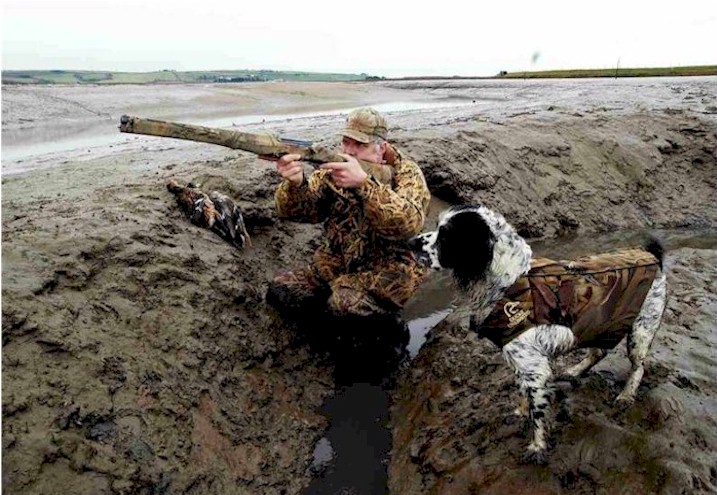
Have a go at puntgunning
Though these pictured here are not puntguns like “Irish Tom”, the 14ft boat-mounted gun on display at the BASC’s headquarters, you can take any non-powered craft out after duck and geese. BASC’s advice is that the best place is Scotland. Give BASC Scotland a ring on (01350) 723226 to say where you are going. BASC can also put you in touch with local guides.
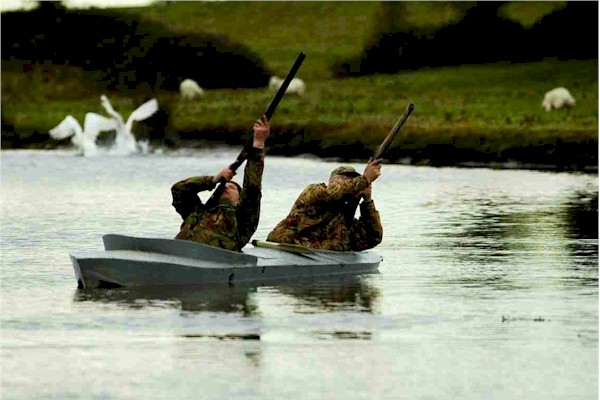
‘With our very fast tides, our estuary is not best suited to shooting in punts’
Brian Stimpson
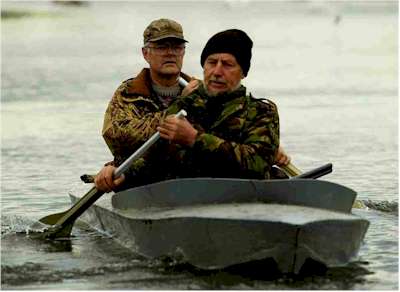
The club has secured the crown foreshore lease after years of negotiation with other estuary users.
In 1976, the club was fully affiliated to WAGBI, now BASC and, with the help of the organisation, our club finally secured the crown foreshore lease in 1996. This was achieved after nine years of negotiation with other estuary users like English Nature, the RSPB, local councils and the MoD.
Roll on the cold fronts
We normally welcome the cold weather that comes in from Central Europe because it pushes before it the migrant duck and woodcock populations ever further south and westward in our direction.
When previous bans were imposed, we benefited from boosted quarry numbers in our relatively milder weather conditions and resented the loss of our potential duck bonanza.
In our first year, however, our first management decision was to impose a severe weather shooting ban ahead of the rest of the national ones, since we were unusually badly hit by prolonged freezing weather.
A role in the local community
Our club has served on the local estuary forum since it was formed in 1988, along with other conservation groups, local councils, leisure and business interests as well as the MoD.
Its main function is to act as a non-political pressure group against inappropriate development around the estuary, prevent pollution and address potential inter-group differences across the table. Matt, our former honorary secretary, served as its vice chairman for several years.

